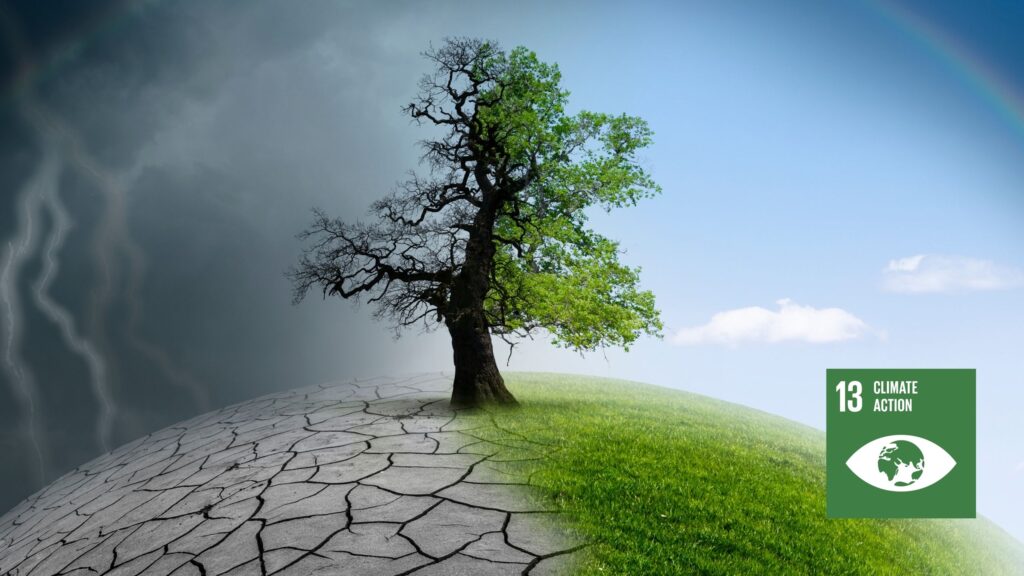
SDG13, Climate Action – An Update

Dear  Mankind and most favoured of my children 

You will recall my earliest blogs ( mother Earth blogs ) welcomed the Global initiative to develop the Sustainable Development Goals ( SDGs)  to help create a safer and fairer world and I was happy that Mankind had at last understood the need to live more sustainably and harmoniously with other living things on this, our only, home. Some good progress was starting to be being made in some areas but sadly most of this encouraging activity was brought to an abrupt halt  or in some cases, even reversed by the COVID  19 Pandemic. 

This blog on SDG 13 – Climate Action is the next in  a series of updates to review the effects of the COVID 19 Pandemic  on the aspirations and targets of each of the  original 17 SDGS and to look ahead to the prospects in each sector. 

Despite the pandemic related economic slowdown in recent years, the  climate crisis continues largely unabated. Concentrations of greenhouse gases continued to increase in 2020 reaching new record highs and it was one of the 3 warmest years in human record. 

However, climate action is now getting some  momentum. In  June 2020, a campaign was launched to form a coalition of businesses, cities, regions and investors around net zero carbon emissions and initiatives. This  set specific “tipping points” for more than 20 sectors of the Global economy. As of  December 2020, two thirds of the  world’s GDP was being generated in places with actual or intended net 0 targets for 2050. This covers half of the world’s population and emissions and is a  promising development.

In 2015, 196 parties to the Paris agreement committed to transforming their activities  to increase sustainability and called for limiting Global warming to well below 2°C to meet Global carbon dioxide emissions which need to be reduced by 43% by 2030 from 2010 levels so that they can reach net zero emissions by 2050 .  Covid pandemic significantly reduced human activities in 2020, leading to a temporary fall in CO2 emissions mostly in the developed countries but  sadly, despite this temporary reduction, evidence indicates that the Global  concentration levels of CO2, Methane and Nitrous oxide continue to increase in 2020.  By December 2020 emissions had rebounded back  and were registering 2% higher than the same month in 2019.

By May 2021,  192 parties ( including 125 out of 154 developing countries ) of  the Paris  Agreement had  submitted their first voluntary reports ( NDCs) reporting on their  efforts. Increasing numbers of countries are developing  National adaptation plans to boost their efforts to adjust to climate change. This includes building flood defences, early warning systems for cyclones or switching to drought resistant crops. Finance provided by the developed to developing countries has been increasing, reflecting an ongoing commitment to support the global transition to  a low emission / climate resilient future.

Mother Earth  

Sources : extracted from The Sustainable Development Goals Reports 2019 -2021 , United Nations, New York

SDG 12 Responsible consumption and Production – An Update

Dear  Mankind and most favoured of my children 

You will recall my earliest blogs ( mother Earth blogs ) welcomed the Global initiative to develop the Sustainable Development Goals ( SDGs)  to help create a safer and fairer world and I was happy that mankind had at last understood the need to live more sustainably and harmoniously with other living things on this, our only, home. Some good progress was starting to be being made in some areas but sadly most of this encouraging activity was brought to an abrupt halt  or in some cases, even reversed by the COVID  19 Pandemic. 

This blog on SDG 12 – Responsible consumption and Production is the next in  a series of updates to review the effects of the COVID 19 Pandemic  on the aspirations and targets of each of the  original 17 SDGS and to look ahead to the prospects in each sector. 

Growing global population combined with unsustainable use of natural resources is having a devastating impact on the Planet and propelling climate change, destroying nature and raising pollution levels. Around 14% of the world’s food is lost along supply lines chains before reaching the retail level. One million plastic drinking bottles are purchased every minute and 5 trillion single use plastic bags are thrown away each year . Each person generates 7.3kg of e waste but only 1.7kg of it ever gets recycled .  As a result of such activities  the global material footprint increased by 70% between 2000 and 2007.

Globally, domestic material consumption per capita (the total amount of material directly used by any country) rose by more than 40% from 2000 to 2007.  Whereas the rise in industrialised countries was due largely to increased consumption, the rise in developing countries was mostly due to industrialisation. There is some evidence  of a positive trend in development of activities and strategies. By 2020, the  richest countries and the European union reported a total of 700 policies and implementation activities under the framework of programs for sustainable consumption and production.  However, only 50 policies and implementation activities were reported in sub-Saharan Africa compared with the 374 in Europe and North America so more support needs to be given to the developing world. The Covid recovery strategy provides a window of opportunity to design and build  sustainable and reliable economies and societies in all countries around the world. 

The disposal of e-waste causing poisonous chemicals to be released into the soil and water remains a major problem and also results in significant loss of scarce and valuable raw materials such as gold, platinum ,cobalt and rare earth elements. E waste quantity is expected  to grow annually but the processing capacity to recycle e waste is not increasing at the same rate. This is most unfortunate, because as much as  7% of the global gold might be contained in e-waste which we throw away.

Fossil fuel subsidies were expected to decline but despite a very small reduction ( mainly due to covid effects) they still amounted to $432 million in 2020

Mother Earth  

Sources : The Sustainable Development Goals Reports 2019 -2021 , United nations, New York